Architecture at a Glance
%%{init: {'theme': 'default', 'themeVariables': { 'background': '#ffffff', 'canvasBackground': '#ffffff', 'primaryColor': '#fff' }}}%%
flowchart TD
    subgraph ClientLayer [Frontend - React FSD]
        CustomerUI[Customer Virtual Queue]
        BusinessDash[Business Analytics Dashboard]
        AuthInterceptor[JWT Silent Refresh Interceptor]
    end

    subgraph ServerLayer [Backend - Spring Boot 3.4]
        APIv1[REST API Bounded Contexts]
        QueueLogic[Queue Management Domain]
        AnalyticsEngine[Real-time Data Aggregator]
        SecurityFilter[Auth Filter - HttpOnly Cookies]
    end

    subgraph StorageLayer [Persistence]
        PostgresDB[(PostgreSQL)]
    end

    %% Data Flow
    CustomerUI --> AuthInterceptor
    BusinessDash --> AuthInterceptor
    AuthInterceptor --> SecurityFilter
    SecurityFilter --> APIv1

    APIv1 --> QueueLogic
    APIv1 --> AnalyticsEngine

    QueueLogic --> PostgresDB
    AnalyticsEngine --> PostgresDB

    %% Styling
    style ClientLayer fill:#f9f9f9,stroke:#333,stroke-width:1px
    style ServerLayer fill:#f9f9f9,stroke:#333,stroke-width:1px
    style StorageLayer fill:#f9f9f9,stroke:#333,stroke-width:1px
    style PostgresDB fill:#e1f5fe,stroke:#01579b
The Problem
Traditional physical queues cause service bottlenecks, resulting in lost revenue and poor customer experiences for high-traffic businesses.
The Solution
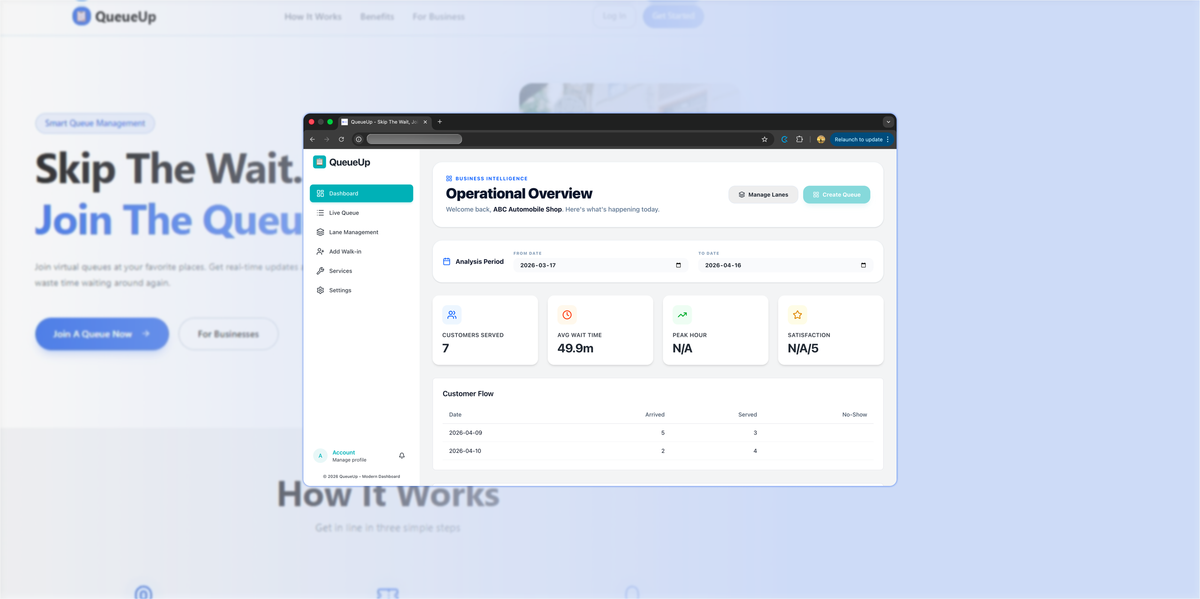
We engineered a virtual management system using a domain-driven backend and a modular frontend to deliver real-time wait tracking.
The Impact
The platform empowers businesses to eliminate crowding while providing customers with a transparent, low-friction journey. It turns operational data into actionable insights for the service economy.